
Services
We offer a wide range of services to understand better and diagnose your hearing abilities.









Hearing Testing Services
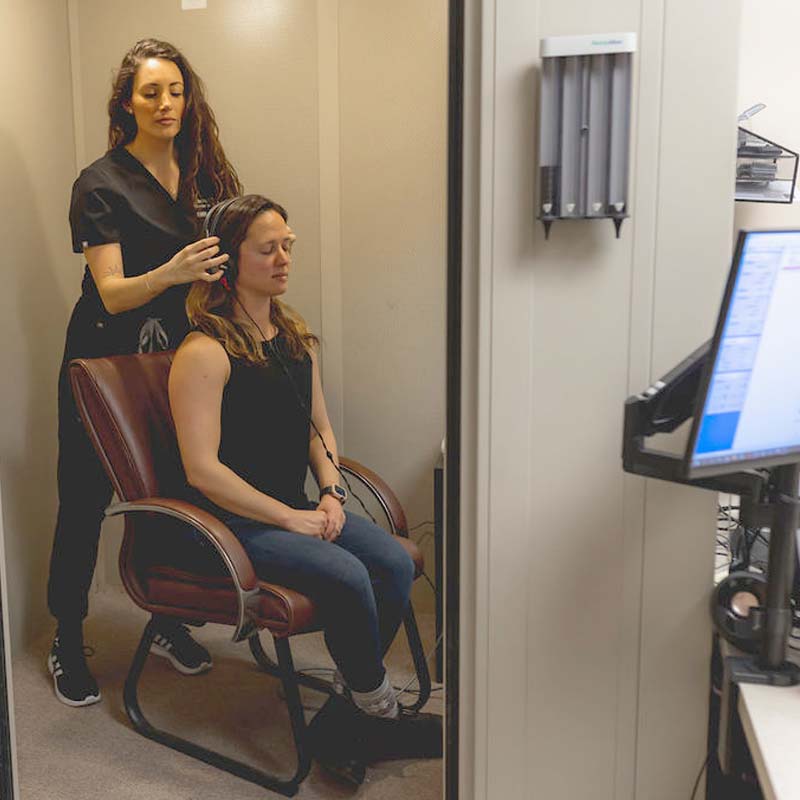
Pure Tone Audiometry
This test determines the hearing abilities of patients concerning different frequencies or pitches of sounds. The softest audible sounds are plotted on an audiogram or graph representing hearing sensitivity. This information helps quantify the hearing loss and is one determining factor in hearing device candidacy.
Speech Audiometry
Comprised two subtests. First, the patient is familiarized with a list of two-syllable words and then is asked to repeat back the words at decreasing levels of loudness until the patient can no longer successfully repeat back. This test is used to judge the reliability of pure tone audiometry. The second test is called Word Recognition (WR). The patient is asked to repeat a one-syllable word at a comfortable listening level to determine the patient’s ability to understand speech in an ideal listening environment. WR testing is also an important indicator of hearing device candidacy and can help predict success with amplification.
Tympanometry
Provides helpful information about the status of the outer and middle ear system, including ear canal volume, ear canal pressure, and the ability of the eardrum to move back and forth.
Acoustic Reflex Testing (ARTs)
Objectively measures the contraction of the middle ear muscles, known as the ossicles, in response to loud sounds
Otoacoustic Emissions (OAE) Testing
This objective test assesses the integrity of the outer hair cells located within the cochlea, the organ of hearing. OAEs are useful when testing infants and young children who are unable to participate in traditional pure tone audiometry. People with normal hearing usually have OAEs so it can be a useful tool in the diagnostic process.
Baseline Hearing Test
A baseline hearing test will include all of the services listed above. The results will be used to make future comparisons about change of hearing abilities over time. A baseline hearing test is recommended to all adults prior to noticing a problem with hearing. After a baseline is complete, the audiologist will make recommendations for further care, which may include annual hearing re-evaluations, hearing aids, or a referral to a medical doctor.
Hearing Aid Services
Pure Tone Audiometry
This test determines the hearing abilities of patients concerning different frequencies or pitches of sounds. The softest audible sounds are plotted on an audiogram or graph representing hearing sensitivity. This information helps quantify the hearing loss and is one determining factor in hearing device candidacy.
Speech Audiometry
Comprised two subtests. First, the patient is familiarized with a list of two-syllable words and then is asked to repeat back the words at decreasing levels of loudness until the patient can no longer successfully repeat back. This test is used to judge the reliability of pure tone audiometry. The second test is called Word Recognition (WR). The patient is asked to repeat a one-syllable word at a comfortable listening level to determine the patient’s ability to understand speech in an ideal listening environment. WR testing is also an important indicator of hearing device candidacy and can help predict success with amplification.
Tympanometry
Provides helpful information about the status of the outer and middle ear system, including ear canal volume, ear canal pressure, and the ability of the eardrum to move back and forth.
Acoustic Reflex Testing (ARTs)
Objectively measures the contraction of the middle ear muscles, known as the ossicles, in response to loud sounds
Hearing Aid Consultation
Not sure if a hearing aid is right for you? Let us test your hearing and see if you are a candidate. Based on your lifestyle and hearing loss, hearing aids will be recommended. Demo a pair of hearing aids to find out first-hand what the aids feel like and sound like. If you decide to proceed with the selected devices, a hearing aid fitting is scheduled at the patient’s convenience.
Hearing Aid Fitting
The next step is the actual hearing aid fitting. Hearing aids are digitally programmed using the results gathered from the diagnostic hearing test. Real Ear measurements are taken to determine the actual sound delivered at the level of the ear drum from the hearing aid by inserting a thin microphone in the ear canal. After you approve the sound quality and comfort of the aids, information is provided so you can care for the aids independently. Battery changing is practiced and cleaning protocols are discussed.
At the conclusion of the session, you are taught how to insert and remove the aids and also how to manipulate any controls on the aids. After all questions are answered, we will schedule a follow-up for one to two weeks. All patients are given a 45 day adjustment period. If the patient decides to return the hearing aid during this adjustment period, a full refund will be given minus a fitting fee.
Tinnitus Services
What Is Tinnitus?
Tinnitus, or ringing in the ears, is an auditory sensation of hearing a sound in the ear when no external sound is present. Tinnitus is a common problem that affects about 1 in 5 people. Although the ringing in the ear can be bothersome, it usually isn’t a sign of something serious.
What Are The Symptoms Associated With Tinnitus?
Tinnitus can sound like the following noises: Ringing, Buzzing, Roaring, Clicking, or Hissing. Some people experience tinnitus in one ear, while others hear it in both ears. Patients often perceive tinnitus to be louder in a quiet environment.
If you are experiencing tinnitus or ringing in the ears, call our office to schedule your tinnitus evaluation. For all tinnitus patients, we perform a complete medical history and a hearing evaluation. This appointment takes approximately one hour.
For more information regarding Tinnitus, visit the Mayo Clinic’s Tinnitus Information Center.
